Pages

Wednesday, January 7, 2026

Making a muff for Mom

Well, it's a new year, and a lot has been going on!

One of those things is that my 94 year old mother is currently in the hospital, and we've been really pushing for them to NOT discharge her back to her apartment.  She actually wants to be in a nursing home and we've been trying to get her approved for one.  It's our provincial government run health care system that decides if she's allowed to be in one, though.  It's been two years of trying, while she's been getting increased amounts of home care, but as long as she had home care, and I was able to cover for them the many times they were short staffed, she was considered able to live independently.  It's an incredibly cruel system.

My mother got to the point of using her Lifeline to call an ambulance to take her to a small local hospital, after weeks of increased swelling, and my siblings and I have basically told them, flat out, she can't go back to her apartment.  It isn't safe for her, and none of us are in a position to take her in.  In my case, I've got a disabled husband, I am now officially disabled as well, and none of us have homes accessible enough for her.  Plus, we're all getting on in years ourselves.  I'm the baby of the family, and I'm now 56.  My sister, the oldest, is almost 70.

They seem to accept that she cannot be discharged to her apartment (her needing help because she fell off the toilet served to prove that even more), and she has been there through Christmas and New Year's, but they don't seem to be doing much for her.  Every time I visit her, she tells me the doctor (there is a rotation of 5 doctors) hasn't even seen her, and no one has been able to give us a straight answer as to what the next step for my mother will be.

One of the things she has complained about is how cold she is.  Her hospital bed had only a sheet and she asked for a blanket.  They gave her one thin blanket and she was still cold, but they never gave her another blanket.  My SIL was able to bring her one from their home during a visit, and I was later able to bring her another from her apartment, but for a while she was sleeping with her parka over her sheet to get warm!  We've also had to bring her her sleep slippers, because her feet get so cold at night.

When she saw the hat I made for myself, pictured in my last post, she mentioned her head got cold at night, too.  So I made a simple hat for her, using the same variegated grey and cream yarn that I used for my own hat.

She has been very happy with it, and wears it every night.  During a recent visit, she told me that she sometimes even tucks her hands into it to warm them up.

So today, I made what will be a surprise for her.  A muff for her hands.

I didn't have enough of the blanket yarn I used for her hat left to make a muff, so I had to get more blanket yarn.  The only place locally that carries blanket yarn is a dollar store in the same town my mother is currently in.  They didn't have the variegated yarn, but they did have a solid grey that matches one of the greys in her hat, so I got that.

The design is really basic.  A tube, twice the length needed, folded in on itself to get a double thickness, then closed up at the end.

To be able to fold it in on itself, I made the second half slightly narrower.  Here is the finished tube.


Using a 7mm hook, I made a starting chain of 30 ch joined into a circle, then did a 30 sc round into the chain.  After that, I did rounds of dc, using my own hand to decide the length needed.  After 11 rounds of 30dc, I did one round of 30 sc, then a second round reduced to 28 sc.  I used a bit of cotton yarn to mark between the two sc rounds, as the fluffiness of the blanket yarn made it harder to see.

Once it was reduced to 28 stitches per round, I did another 11 rounds of dc, then finished the tube with one round of 28 sc.

I had enough of the variegated yarn left to use as an accent so, before I folded the tube in half, I did a round a slip stitches between the rounds of 30 and 28 sc, using the solid grey.  This would give me something easier to stitch into, later.  

When I started the new ball of yarn from the centre, pulling out a small yarn barf, I discovered the yarn had a break in it.  That came in handy, as I was able to use this extra bit of detached yarn to do the slip stitching.  Otherwise, I would have found the opposite end of the working yarn and used that.  

Doing the slip stitch was a bit awkward, as the working end of the yarn had to be on the inside of the tube, so I was basically going by feel when it came to pulling up loops.  It got easier once the first two or three ss stitches were done.


In the above picture, you can also clearly see where my starting dc stitch for each row is!

In flipping the tube in half, I would need to pass the yarn through the tube, so I re-balled it to make it easier to push through the tube without getting everything all tangled up.  It was still a tight fit, but I got it through!


The above picture shows the open end, with the 28 stitch half inside the 30 stitch half, ready to be ss'd together.


This photo shows the folded end, with the ss at the very edge.  That row of ss actually made it easier for the tube to fold in half neatly, too.

After that, the open end got ss'd together.


With the tube being two layers thick, it was easy to hide the yarn ends between the layers, after being secured.


Last of all, I did a round of sc into the slip stiches at each end, using the variegated yarn as an accent.  It tidied up the ends quite nicely, too.  


The finished muff has enough space to fit both hands snuggly, but not too tight.  My mother has hands similar in size as my own, so it should work out quite well for her.

It'll be at least a couple of days before I can visit my mother at the hospital again, but when I do, I'll have a nice, cozy surprise for her to keep her hands nice and toasty!


Tuesday, December 9, 2025

A quickie

Crafting has become more difficult for me, for the past few years.  Most of my time in the summer is spent working outdoors.  That does mean less time for crafting, but it also means my hands become too rough to handle things like many types of yarn while trying to crochet.

The other issue is that we have rescued too many yard cats. I no longer have access to my craft table, and most of my supplies have had to be stored up I bins to protect them from inquisitive and destructive beasts!

Today, however, I did a very quick project.  My daughter bought me some blanket yarn.  That, and a 7mm hook, resulted in this.

A very quick, very warm, hat.

The body is done in rounds of double crochet until the ear flaps were made.  Those were done in rows over 3/4 of the hat, skipping the section that would go over the forehead.


I changed stitch lengths to create ear flaps, doing sc, hdc, dc, hdc, sc over 1/4 of the hat on opposite sides, until the rows reached the bottom of my ears when i tried it on.  When it's windy and cold, I get severe ear aches.  If need be, I can fold the flaps for extra thickness.

The ear flaps rows in the back quarter of the hat are done with single crochet only, so it is shorter and won't get pushed up when I move my head.

The hat was finished with two rounds of single crochet.

That's it.

Taking out the times I was interrupted, it took maybe an hour to make.

Also, blanket yarn dies not get caught on the rough skin and callouses on my hands. 

I'm quite happy with it.


Monday, October 20, 2025

Trying something new

Well, it has been ages since I posted last!  It has been a very hectic year, and I've done very little crafting.

With a somewhat extended fall, I've been busting my butt getting things in the yard and garden cleaned up, readied and put away for the winter.  Today, however, we had rain all day.  Which is great, because it isn't snow!  It also meant I had time today to try a new craft.

I have had a Martha Stewart loom weaving kit for quite some time.  I got it to do loom knitting, but never really got the hang of it, and didn't enjoy it enough to keep trying.  So it's just been sitting there.

Recently, I had something pop up in my Pinterest feed that caught my attention.  It was peg weaving, but on the diagonal.  From the photos and diagrams, I could see that it started from the in middle of a square peg loom and worked outwards, and I was pretty sure I had figured it out, but none showed how the project was finished.

I went looking for a video and found this.


I'm glad I found it, because it turned out I hadn't understood the diagrams or photos for starting it, either!

I really like the concept.  You work with a continuous strand of yarn, and the top and bottom are woven at the same time, in each pass.

So I dug out my loom weaving kit and put together a small square peg loom.


The pegs form a square of about 4 1/2 inches.  A good size to learn on, and to make something coaster sized.  I had a longer Tunisian crochet hook that I used, rather than the super long hook in the kit.  

I had some smaller balls or medium weight yarn I could spare for learning and got started.  My first square, using a plain white yarn, was done very quickly.  Compared to the crochet I usually do, it used almost no yarn at all.

The tutorial video said that the weaving would be smaller after being removed from the loom, and I expected the yarn to relax and form a tight weave.

I was wrong. 

I tried again with a slightly thicker yarn, which happened to be a reflective yarn.

Here are my first two squares.


I wasn't very happy with the thicker yarn, either.  Especially the loose and floppy edges,.  I also didn't see how the method of securing the end of the yarn as in the video would hold for long.

I tried a third one, using both yarns.  With such a small loom, I also found it easier to work the yarn near the top of the pegs, rather than pushing it down to the bases.

At the finish, I tried securing the end (using a large plastic yarn needle from the kit) by weaving it along the edges, inside the pegs, until I ran out of the tail end.

Better, but I still wasn't happy with it. 

I made a fourth one.  This time I used two different colours of the thicker reflective yarn.

Here is how it looks, finished, before removing from the loom.


Doubling up the thicker yarn was much nicer.  I also finished by cutting a tail end long enough to wrap around the pegs five times, then went around the edges doing a back stitch, right against the inside of the pegs.  

Having pegs that could be removed helped.  The back stitching made it pretty tight around the pegs, making harder to slide the loops over the flared tops of the pegs.

Here are the four squares I made, numbered in the order I made them.


The top two are single strands of yarn, the bottom two are doubled.  

The last one, the blue and grey with the back stitching, holds its shape really well.  From the front, you can't really see the back stitching, as it disappears into the weave, but it forms a sort of ridge on the back, so it doesn't really sit flat.

The white and grey's edging is even with the weave; no ridge at all.  Weaving the ends through while 
on the loom basically resulted in a running stitch.  In the end, I think that worked out nicer than the back stitch.  

These work up so quickly, it would be easy to churn out a dozen or so in no time.  It's also very satisfying to work on.  I wonder if I have a heavy variegated yarn in my stash?  It would be interesting to see if any patterns emerge, from having the top and bottom being woven at the same time.

Definitely something I want to keep experimenting with - on days like today, when I can't be working outside!


Monday, December 23, 2024

2024 Christmas ornaments: Singlade balls finally done

Talk about down to the wire!

I actually finished the first 5 of these much earlier, but it took forever for me to get to that last one.

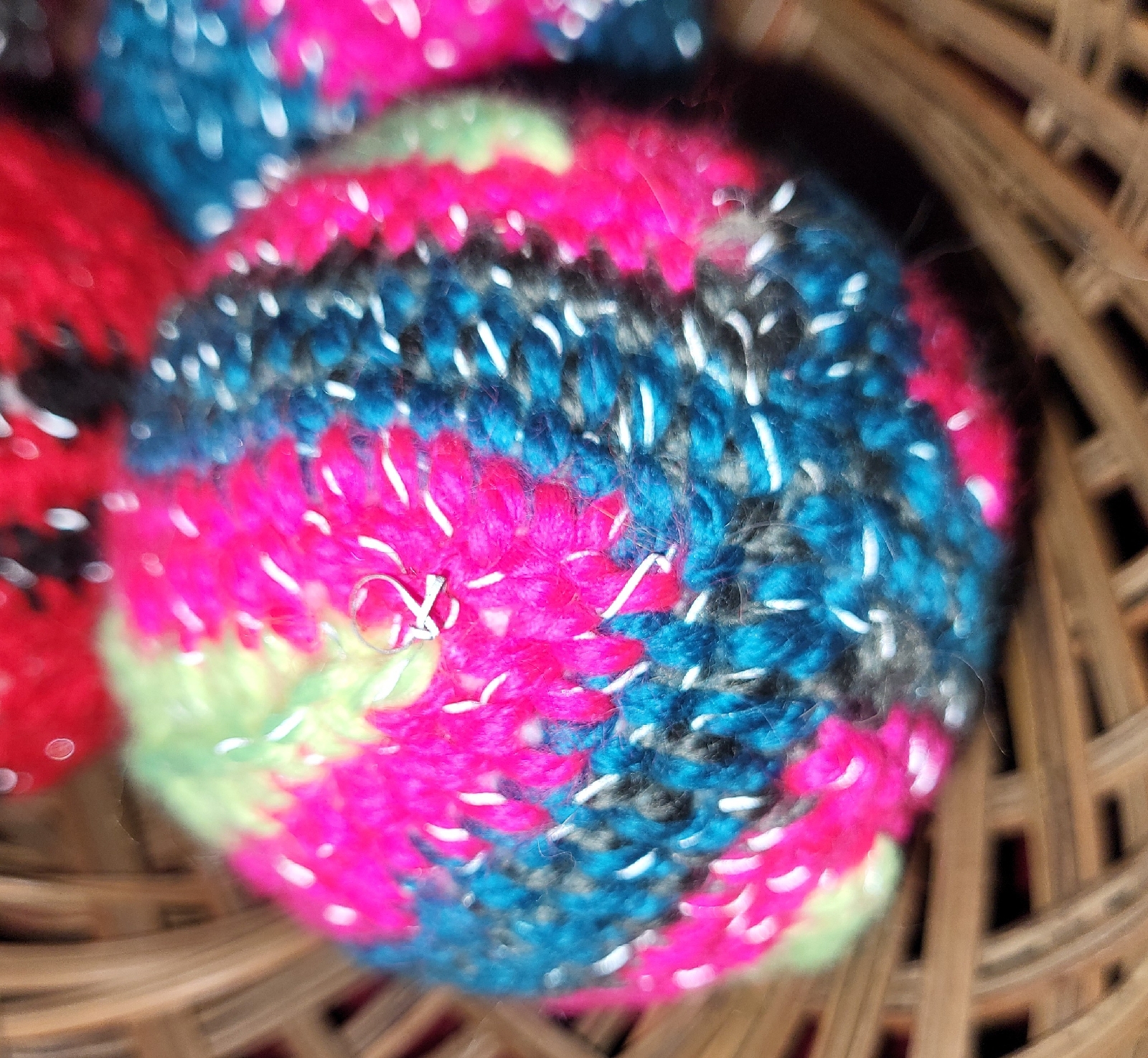
Here are the finished Singlade balls.  As I used reflective and sparkling yard, I took photos in a dark room with flash, so they're not the best quality, I'm afraid!


Here are all six of them.  I used leftover yarn from other projects, and it was a matter of using what I had enough of, when it came to the colour combinations.


Here is one made up of grey and hot pink reflective yarn.  Each triangle is done the same way.


For this one, I used black reflective yard to border the triangles, red yarn with a silver metallic strand, and a tiny accent of neon yellow reflective yarn.


With this one, I did alternated using the dark green reflective yarn and the peacock blue, together with the red sparkle yarn.  I had intended to do all green and red, but didn't have enough green.


This was actually the last one I did, and changed up from doing 8 triangles to 4 oblong shapes, all in reflective yarn.  The blue and grey were in alternating single rows, then two rows of the hot pink.  I changed the stitch for the neon yellow in the middle, to create a raised line down the centre.


This one was pretty basic: solid triangles in hot pink and peacock blue reflective yarn.


This one was actually one of the first I did.  Red sparkle yarn with a reflective black yarn accent.

I'm rather happy with how these turned out.  For these first Singlade balls, since they were specifically for Christmas ornaments that I wanted to be sparkly, I used thicker yarn than I otherwise would have.  It made for chunkier stitches and you can see the white base in some places, in between the stitches.  If I were to do these again, I think I'd try making smaller ones using variegated embroidery yarn.

Christmas for us this year is a much quieter one, with minimal decorations.  These will be a table decoration in their basket.  If we wanted to hang them, I would use simple wire hangers.  The reflective and metallic strands in the yarn are the focal points in them.

This is definitely an enjoyable, almost meditative, craft that I would definitely recommend.


Sunday, November 10, 2024

Something new for our 2024 decorations

Well, it's that time of year!  Time to work on our annual, hand made Christmas decorations.

This is something I've been trying to do every year for quite some time, missing only a few years due to personal circumstances.

This year has been a bit different, in that my challenges are more physical in nature.  Osteoarthritis has set into all the joints of my fingers, making finer motor control more painful.  I'm losing my grip strength, and drop things far more often.

I can still do big stuff, though.  Manual labour, which is something I enjoy doing, is still an option for me.  Mostly, that involves gardening, but also all sorts of other outdoor chores and activities.  Most recently, my big project has been building an isolation shelter for our more feral yard cats that we will have to trap to get spayed.  They will need two weeks of monitoring as they recover.  Using what scrap pieces of lumber and salvaged material we could find around the property, with a few items that needed to be purchased, we now have a two level cat shelter on wheels that we will be able to use to isolate any cats from the colony we are caring for.  It even has a heat lamp, food bowl and heated water bowl set up in it, and the cats are already using in and getting used to it.

The down side of all this is that my hands have become very rough.  I don't crochet much anymore, as most yarns get snagged on my fingers and pull off the hook, or fray.  Some yarns are okay, but few yarns I'd like to use for most of the projects I'd like to be working on.

All of these factors had to be considered as I decided on this year's Christmas decorations.

In the end, it was a Pinterest suggestion that lead me to a new craft I decided to try this year.  Making Singlade balls.


This project has a lot of similarities to the temari I've made in the past.

Of course, I use the materials I have on hand, so for this project, I cheated a little.

I had a 6 pack of Styrofoam balls handy, so those are the core of the balls I am making this year.  I had some white yarn left over from another project, and that's what I used to wrap around the foam core, then secure the strands, the same way I wrapped sewing thread around the core of a temari project.


Here, you can see how things are going so far.  Once the cores were wrapped, I found some cotton yarn that I used to divide the balls into 8 sections.  This is also similar to temari, without the need to be so precise.

From there, the sections just needed to be filled using buttonhole stitch (also called blanket stitch).

With these intended for Christmas decorations, I like to include sparkling or reflective elements. I was able to include both.  I had some red yarn with a silver metallic strand in it, plus a bag full of leftover bits of reflective yarn.  

I've finished stitching up two balls so far.  I started one in red and green, but didn't have enough this green yarn to do both halves, so the other half was done in blue.  

I still haven't decided on how I will attach hangers yet.  I also have some miniature Christmas decorations I might use to jazz them up a bit.  For now, I'm just focusing on stitching them up.

This yarn is a lot bulkier than what is used in the video tutorial, so these do work up fairly quickly.  Working with a needle and thread has proven to be easier on my hands, and the yarn doesn't have as much opportunity to snag, compared to crochet.  

I do miss crocheting, though!

I'm happy with how these are turning out so far.  In the future, I can see making some of these using actual scrap bits, like in the video, but with something like a bell and maybe a bit of catnip, inside.  They would make great cat toys!

So that is what we are doing for our Christmas decorations this year! 

How about you?  Are you doing any special crafting for the season?


Tuesday, July 9, 2024

Old tools

I haven't been doing much crafting lately - unless you consider rebuilding garden beds and planting, crafting!  We have had so much rain this spring, everything it set back by it.

Yesterday, my mother gave me some storage bins of stuff.  Mostly fabric odds and ends, and other stuff she hasn't touched in years.  There were some treasures tucked among them, though, including a lacy thread crochet tablecloth my mother made herself.  I believe she finishes it before I was even born, which would make it more than 50 years old!

There were also old crafting tools and sewing supplies that had belonged to her laye aunt, and a few of those may well be even older!  Here are some of them.


I tried to get legible photos of both sides of the hooks.

The thread crochet hooks are some of the smallest I've ever seen!  I will be looking up the brands for some of them.  Only the Boye brand is familiar to me.  At least, when it comes to crochet hooks.

My late great-aunt was an amazingly skilled woman, and I have a few of her fine crochet lace and embroidery pieces.  Some of the embroidery is on sugar and flour sack fabric.  It's amazing what beauty she could create, with so few resources available!

As for the hook with a point at one end, I can't quite remember what that is for!  I'll have to look that up, too.  I have seen similar before, but the more I try to remember, the more it escapes me! 😂


Wednesday, February 28, 2024

A quick incense burner

I have some incense sticks I really like, but they are ever so slightly too wide for the burners I have.  I have to carefully scrape one end of the sticks to get them to fit, and even then, they easily break when I try to set them in the burners, or fall out.  Not a good thing to happen with a lit incense stick!

So I picked up some cheap dollar store, oven bake, no name, modeling clay and made a new burner.

It's not the greatest, but not bad, considering I've never done anything like this before, and have no modeling tools.

Of course, as soon as it was cooled down from being baked, I had to test it out!

For the "bowl", I used the inside of a small dipping sauce bowl as a mold to get the shape I wanted.  Then I rolled out a small amount of dark brown to create the decorative lip around to top edge.  After that, I just made various shapes to decorate the middle out of the light and dark brown clay, while building it up to a depth that would hold an incense stick securely.  

Last of all, I used an incense stick to create the hole in the middle.  The hole goes all the way through so that, if the last, unburned nub of incense were difficult to get out, I could use something to push it out from below.

My makeshift tools were a straight sided water bottle to roll out the clay, a repurposed can to cut the circle, and a bamboo skewer to help position things, then gently tamp them into place, so the layers of clay would stick to each other.

I'm sure all those nooks and crannies will collect ashes, but that's okay.  The main thing is, I finally have a burner to hold my favorite incense sticks!